
Abbey Graveyards and Headstones: What They Reveal About Monastic Burials
Grave markers at abbey sites record centuries of burial. Here's how positions, stones and inscriptions reveal monastic graves and the churchyards that followed.
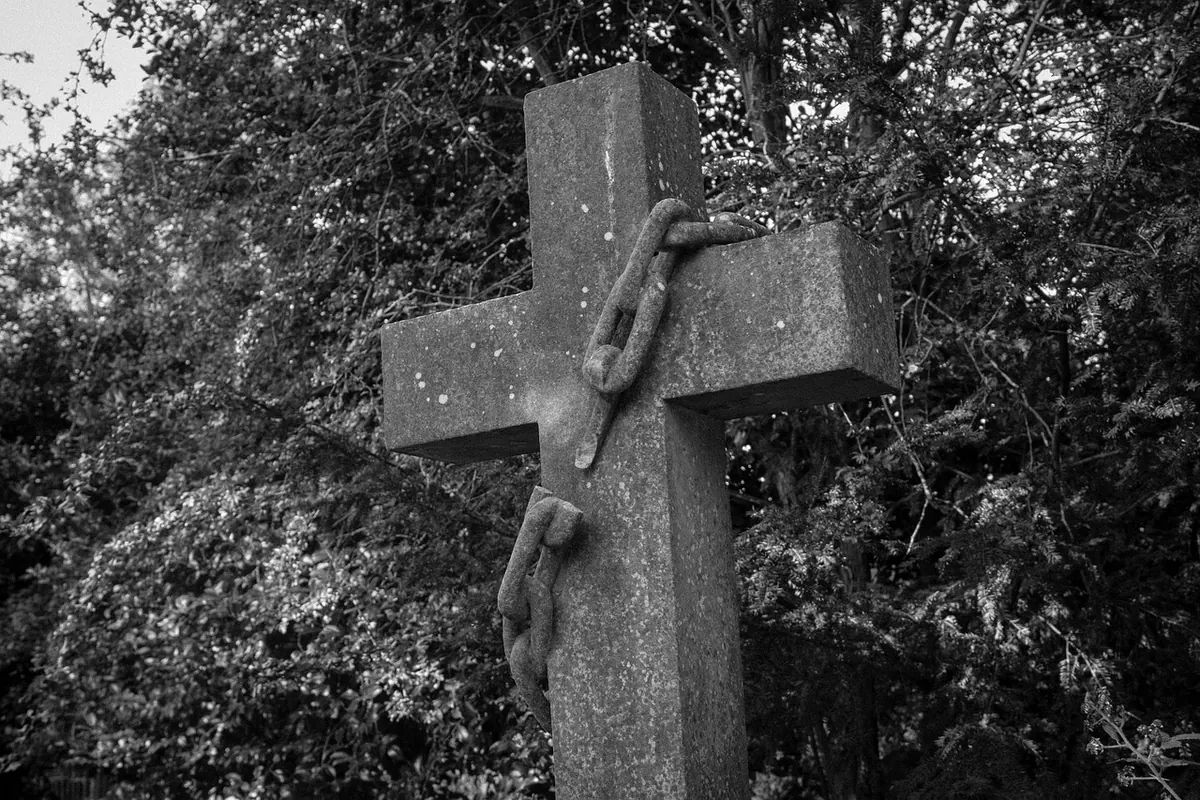
Stand in almost any abbey churchyard and you are standing on a palimpsest. The headstone at your feet may be two hundred years old; the ground beneath it has been dug, sorted and dug again over perhaps eight centuries. Grave markers are the readable top layer of that story, and they say a great deal about who was buried where, what a community believed, and how an abbey's sacred ground was reused long after the monks had gone.
Reading an Abbey Graveyard in Layers
Most abbey sites hold at least three layers of burial. The first is monastic: monks and abbots buried inside the church and the cloister, generally without a standing monument. The second is parochial. After the dissolution of the monasteries, the conventual church often survived as the parish church for the surrounding village, and the ground around it filled with headstones over the following centuries. The third is the churchyard extension of the eighteenth and nineteenth centuries, with family plots, kerbed graves and imported stone.
Each layer leaves different traces. Monastic graves are recognised by position and by the way the ground was cut, not by inscriptions. Post-medieval graves are recognised by lettering, carving and stone type. Because burial ground was reused and reorganised, those layers are now mixed, and a worn medieval slab may sit in a floor beside an eighteenth-century ledger stone quarried from the same local bed.
Where Monks Were Buried, and Why Position Matters
Christian burial in the West has long been oriented east to west, the body lying with the head to the west and the feet to the east, so that the dead rise facing the sunrise. When a grave in an abbey precinct breaks that alignment, it is worth asking why. Clergy are sometimes found the other way round, head to the east, a tradition often explained as the priest rising to face his congregation.
In a monastery the best positions went to the most important dead. Abbots were often buried in the chapter house, where the community met daily, or close to the high altar. Founders and lay patrons were placed inside the church, sometimes in the choir or before a side altar. Ordinary monks were buried in the cloister, either in the open garth or beneath the covered walk, where graves followed the lines of the buildings. A row of cut graves running parallel to a vanished wall is often the clearest evidence of a cloister that no longer stands.
Monastic graves were deliberately modest. A monk's grave might be marked with a plain stone, a small incised cross, or nothing that survives at all. In a monastery, absence is evidence too.
Cross Slabs, Coffin Lids and Effigies
Before headstones, the common marker was the cross slab: a flat stone with an incised cross, most often twelfth to fourteenth century, sometimes accompanied by a chalice, a sword or a pair of shears to hint at a priest, a knight or a wool merchant. Many have been moved, reused as paving, set into floors or stacked against a wall. Once a slab has been moved, its original position tells you nothing, so record the stone itself rather than the spot where it lies.
Effigies are more legible. A figure with a crozier and mitre is an abbot; a chalice and paten, a priest; a sword and shield, a lay patron. Where an effigy lies can be as telling as what it wears: chancel and chapter house for founders and abbots, nave aisles for prosperous parishioners later on. Memorial brasses were widely stripped out, but the empty indent in the stone often survives, a precise outline of a lost figure.
When Headstones Arrive, and What the Stone Says
The headstone as we know it is largely a post-medieval arrival. In most English churchyards it becomes common from the later seventeenth century and dominates during the eighteenth and nineteenth. That shift matters, because it means the stones in an abbey graveyard mostly record the parish era, not the monastic one.
Read the stone itself before the inscription:
- Material. Local limestone and sandstone soften and lose their crispness; slate and imported marble hold lettering for centuries. A slate stone in a limestone district points to stone brought in from elsewhere.
- Shape. Shouldered, round-topped and ogee forms have broad periods of fashion, useful as a rough guide rather than a date.
- Carving. Masons repeated their designs across a churchyard, so grouping stones by hand can reveal workshops and families of masons.
- Position. Rows of stones facing east are the norm; a stone facing the other way has usually been reset or moved.
Symbols worth knowing
- Skull, crossbones, hourglass or coffin: memento mori, mostly seventeenth and eighteenth century.
- Winged soul or cherub's head: the soul ascending, favoured in the eighteenth century.
- Urn, draped urn or willow: neoclassical taste of the later eighteenth and nineteenth centuries.
- IHS, a cross or a chi-rho: Christian monograms found in every period.
- Tools or a trade emblem: the occupation of the person buried beneath.
Inscriptions as Dating Evidence
Language and formula can date a stone better than its shape. Orate pro anima, or "of your charity pray for the soul of", belongs to the pre-Reformation world, when prayer for the dead was part of ordinary belief. After the Reformation that request fades from English churchyard stones; in its place you find forms such as "departed this life" and "in sure and certain hope of the resurrection".
Latin appears more often on clergy memorials, English on ordinary graves. Abbreviations saved space and money: aetatis suae for age, obiit for died. Watch the dates carefully. Until the calendar changed in the mid-eighteenth century, the English legal year began on 25 March, so a stone dated January or February 1730 may actually belong to the following year by modern reckoning.
Weathering is the great eraser. Frost, lichen and pollution take lettering first, which is why indoor ledger stones often remain legible when outdoor headstones a few metres away are blank. A light spray of clean water can lift faint lettering in raking light. Brushes, bleach and acid should never touch a historic stone.
A Practical Method for Recording an Abbey Graveyard
- Ask first. Speak to the incumbent or parish before any survey, and check whether the ground is covered by faculty jurisdiction or scheduling, which may require formal permission.
- Sketch the whole space before reading a single stone: church axis, paths, boundary walls, yew trees, rows and clusters of monuments.
- Work row by row, and record every stone where it stands. Never tidy the record by rearranging stones on paper.
- Photograph each monument with a scale and a north arrow. Early morning or late afternoon light shows worn lettering best.
- Note stone type, shape, carving, orientation and inscription exactly as cut, including spelling and abbreviations.
- Cross-check against parish registers, tithe maps and faculty papers, which often date graves that the stones themselves cannot.
- Report anything unusual: bone at the surface, fresh disturbance, unstable tombs or a stone that has fallen since your last visit.
The one rule that covers almost everything else is restraint. Do not clean, scrub, straighten or move anything. Lichen is part of the monument, and a fallen stone lying face up still has something to tell the next reader. If you find human bone, leave it exactly where it is, cover nothing, and tell the incumbent, who can advise on the correct authority. Recording done carefully is welcome in most churchyards; tidying is not.
Photo: 4175959 / Pixabay